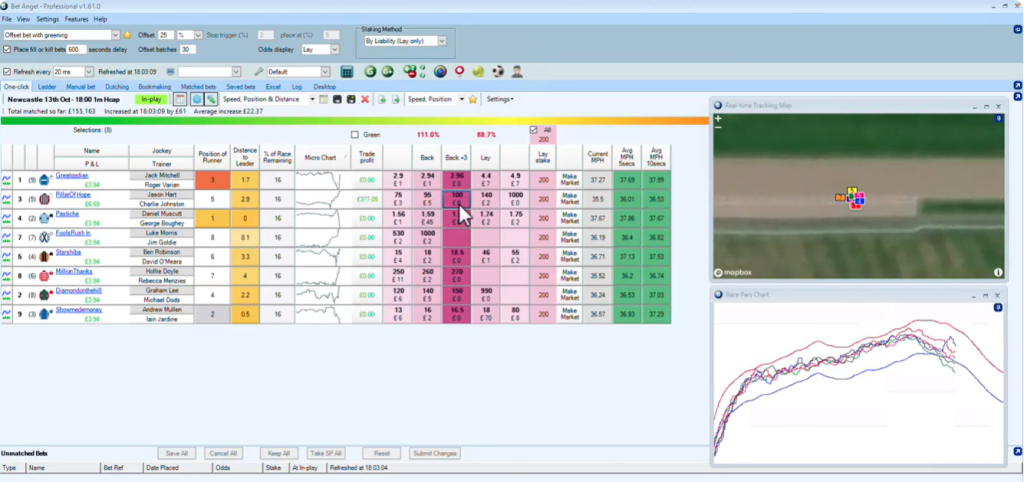
Courtesy of Peter Webb, Professional Betfair Trader and the Proprietor of Bet Angel
Background
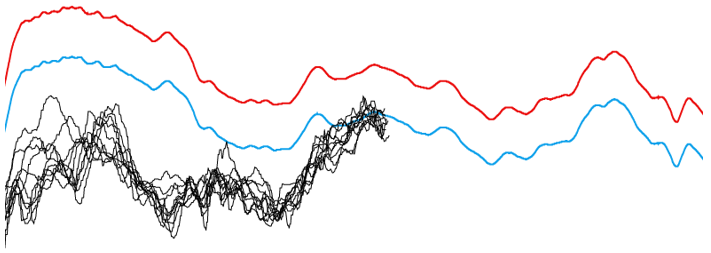
The strategy is underpinned by Race Pars data; These are generated from past performances of winning horses at the course and distance with due regard given to going, ages and class to slightly adjust the race pars to more accurately reflect the optimal running speed.
A typical set-up is shown above; The red line being the fastest 5% (of previously tracked races) and the slowest 5% being depicted with the blue line.
As the race is underway each runner has its own black line and collectively you can see if the race is running slowly or quickly and if the runners are predicted to speed up or slow down. This can be a useful addition to aid in your assessment of how the race is being run
In the example above we can see the race has run to a slow par but the pace is now picking up.
The Strategy
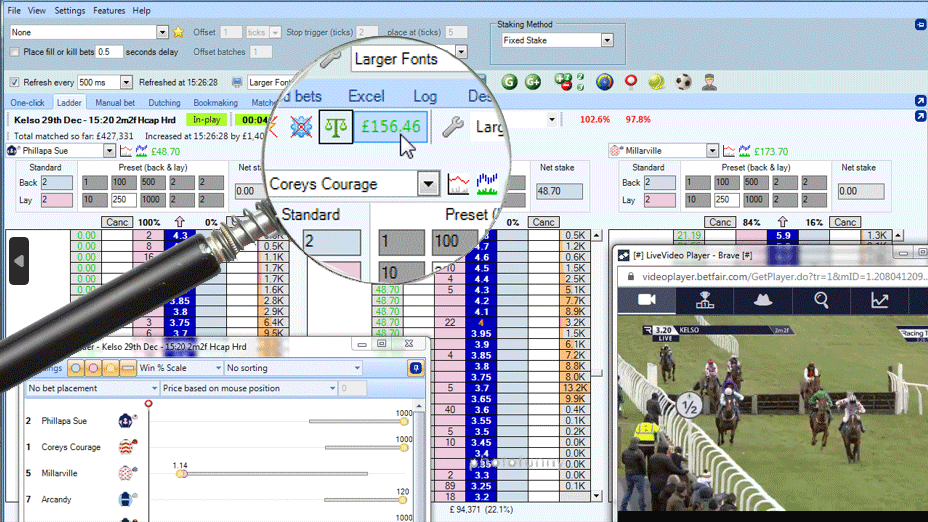
The strategy is described in detail in a Video produced by an associate of TPD, Peter Webb (Professional Betfair Trader and the proprietor of Bet Angel).
The video starts with a basic introduction and description of a traditional lay bet turned into a trade by placing a corresponding back bet, on the same horse, to guarantee a profit regardless of who wins the race.
The video then goes beyond the basics, (04:53) offering a glimpse into more advanced techniques and timing, as lay bets are entered into the market, against the leading horse.
The lay bets being executed at critical moments in the race. And the corresponding back bets are automatically entered by Bet Angel’s “Offset” feature – all demonstrated in the video.
With the help of comprehensive performance data and TPD Race Par charts, the video provides insights on making informed in-play decisions that can increase your trading acumen.
Video Timeline
00:00 – Introduction 00:35 – A simple trade on Horse Racing 01:17 – Trading on Bet Angel 01:56 – Why does this trade work? 04:53 – Doing some a bit cleverer (exploiting TPD Pars data) 05:50 – What was done and why 06:35 – Predicting how the race will be run? 07:44 – How will each horse run? 08:13 – Putting it all together
Whether you’re a seasoned trader or new to the game the video is well worth a watch – CLICK HERE
Previously the sole preserve of Corporate entities, Betfair Exchange Traders and Punters are now able to leverage the considerable power of the TPD in running data, at a very affordable price.
A TPD Zone subscription will enable access to the in running data via either Bet Mover (the in-house TPD Web App), Bet Angel, Gruss Betting Assistant or Bf Bot Manager. Click Here for more details.
The GPS Data
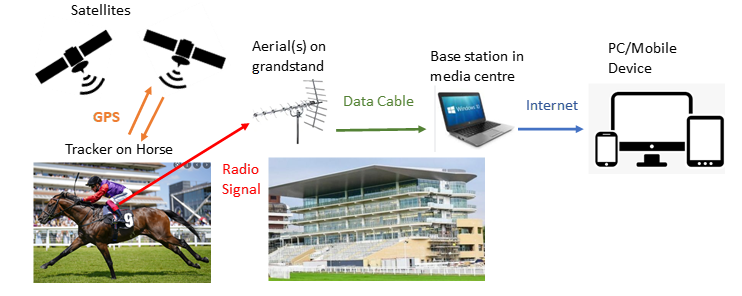
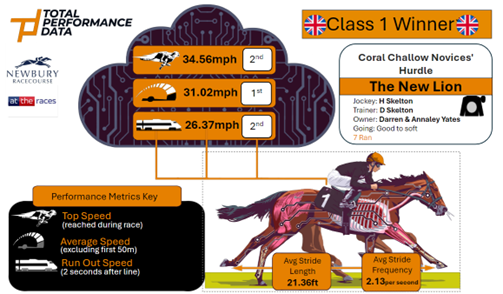
Each horse carries a small sensor unit in a pocket in the number cloth, containing GPS/GNSS, accelerometer, battery and radio components for live transmission. The system uses the GNSS satellite network and associated GPS technology to calculate the live position of every runner continuously throughout the race.
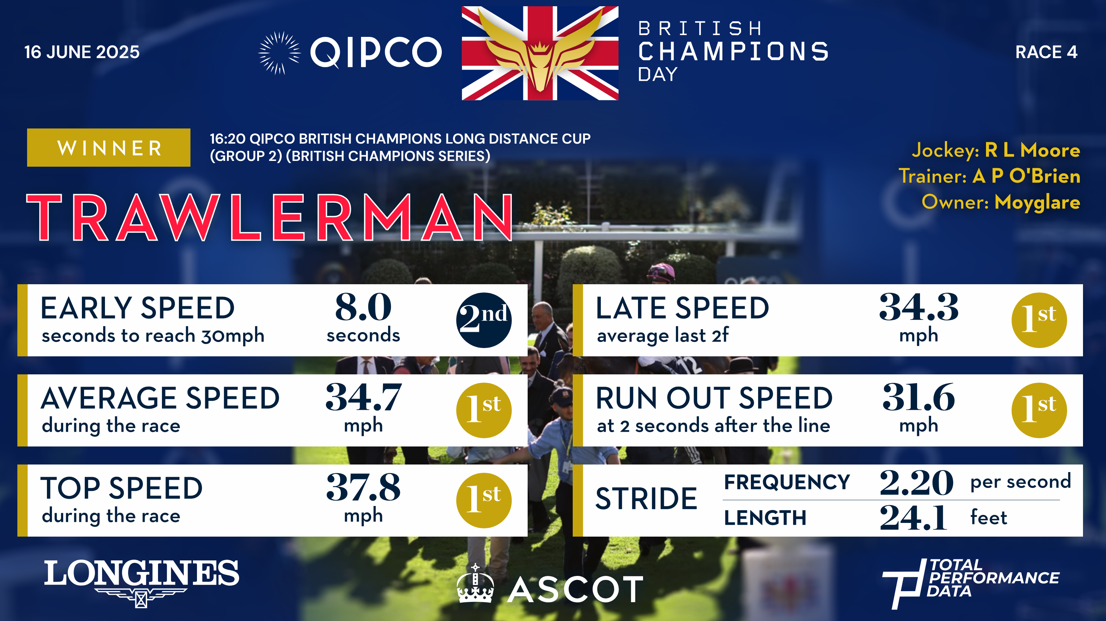
Real‑time positions are updated within fractions of a second and which enables the core outputs to be determined include speed, distance travelled, position, stride length, stride frequency, running order and race timing for each horse. From these feeds, additional metrics are derived such as par speed, velocity fluctuation, cadence error, sectional times and distance to finish, which can be evaluated both in‑running and post-race.
Quantifying Racing Efficiency
The skilful interpretation of racing efficiency is in our view, one of the best routes to success with the GPS data. The in-running data is essentially a quantitative analysis of what you can (and can’t) see on the live pictures.
The power of the TPD data is probably best explained in a video, produced by an associate of TPD, Peter Webb (Bet Angel founder and Professional Trader); Click Here to Play the Video
Click Here for a more comprehensive description of Racing Efficiency and the GPS data.
Limitations of the GPS Data
It is well worth noting that the GPS tracking is rarely going to be 100% accurate and we know that there is an average positional error of a head. However, two errors of that magnitude in opposite directions means an error of half a length. The error is random, each positional update being independent of the last.
This means that one horse can be forward of its advertised position and another inaccurate in the opposite direction accentuating the relative distance between the horses and that is why we do not advocate basing strategies purely on GPS positional data.
Endorsed by Professional Traders
The following comments are from Professional Traders who have successfully employed the GPS data within their trading strategies;
“I recorded a ton of races next to the TPD data to tease out characteristics of why each horse won, why and where it was obvious. That felt a really sensible way to approach the problem. I can read a race visually, but I’ve never been able to put numbers on it. TPD solved that problem for me.”
“I think many expect it to unlock easy profit by beating the market to winners as they cross the line. They are quickly disappointed as current GPS tech is not accurate or fast enough to be hammering 1.01. But it is very useful to build up a data-driven picture of the race as it unfolds and to highlight mid-race value. In summary, don’t expect it to give you a speed and accuracy advantage – expect it to give you a data advantage.”
“……..I should add, the TPD edge is not really in latency, it’s in the power of information in number format. It is NOT accurate enough to try and beat 1.01 on the reported leader at the finish.”
“TPD is amazing given the amount of depth it tells you about a race.”
The skilful interpretation of racing efficiency is in our view, one of the best routes to success with the GPS data. And to quote an industry expert;
“The key thing to bear in mind is that one of the best ways to use the data is to quantify racing efficiency in real time, to identify and lay short priced horses running with the choke out and back horses running efficiently, all at good prices.”
The Trading Platforms
Obviously the Trading Platforms (Bet Mover, Bet Angel, Bf Bot Manager and Gruss Betting Assistant) are all somewhat different in how they display the TPD data, however the following are generic descriptions of each dataset, as provided by the TPD API, (the source from where all the Trading Platforms import the data).
Race Pars
These are generated from past performances of winning horses at the course and distance with due regard given to going, ages and class to slightly adjust the race pars to more accurately reflect the optimal running speed.
A typical set-up is shown above; The red line being the fastest 5% (of previously tracked races) and the slowest 5% being depicted with the blue line.
As the race is underway each runner has its own black line and collectively you can see if the race is running slowly or quickly and if the runners are predicted to speed up or slow down. This can be a useful addition to aid in your assessment of how the race is being run
In the example above we can see the race has run to a slow par but the pace is now picking up.
To quote the TPD CEO; “Very few horses have the natural ability to allow them to win races regardless of how the race pace pans out.
Frankel, eventually, could win from the front the middle or the back of the field.
Elite thoroughbreds can accelerate 3 times in the race, good horses can do that twice and modest horses have a single burst of acceleration. So, watching the speeds relative to the fast or slow par lines (red and blue) can help punters predict which horses will benefit from the pace on the race. Galloping (one paced) horses win from races run near the red line. Smaller (often) horses with a good turn of foot (acceleration) will be suited by race pace that is nearer the blue par followed by a mad increase in the pace late on.
Conversely, if a sprint has taken place (above the red line) early in the race, this will negatively affect those horses who set or were closest to this (wasteful) pace.
Velocity Par Difference (VP)
The difference between the runner speed and the course par speed (at that point of the race). This highlights whether a horse is running too fast / too slow.
Velocity Fluctuation (VF)
A measure of consistency with regard to velocity. A high number may indicate that the horse is not performing well.
Velocity Error (VE)
An algorithmic calculation which results in a number highlighting how ‘off par’ the horse has run from the start of the race.
A LOW number here is preferable and zero would be perfect – however that is highly unlikely to ever happen. A low VE is around 50 and high around 100. It is highlighted that VE (off par) is not reporting the horses positions, it is reporting how close to race par the animal has been running. The horse behind the leader could be running too slowly to par and therefore have a high number. VE is an absolute error value for speed against par speed. It will be high for horses running too slow and horses running too fast.
VE may often be very volatile towards the end of a race; for example, if a horse slows down due to already being beaten or has an unsurmountable lead. Ends of races rarely run close to par and we strongly advise not to rely on this feature towards the back end of races. The feature is to aid decision making in the early part of the race, up to the mid-point of the race.
It is noted that a horse can win with a high VE, but it will have been a very hard fought victory.
Cadence Error (CE)
Cadence corresponds to the horse’s rhythm and it is highlighted that stride length and speed are not considered in the calculation because a high cadence (high number of strides per second) could also mean a shorten stride length and consequently a low speed.
Regularity is the ideal scenario when looking at cadence. It means that the cadence needs to always remain the same, independently of the changes in strides length or speed.
The CE metric quantifies how far a horse is ‘off cadence’ and a low number is best.
Stride Frequency
A count of strides per second; average strides per second recorded in six secs increments , but excluding the first 50 meters. A High SF would indicate a sprinter and conversely a low SF would signify a middle distance runner.
Stride Frequency – Course Par
Both Bet Angel and Gruss Betting Assistant make this metric available, in slightly different guises. The number displayed being the par stride frequency of the course at the selection’s current location.
Splits / Sectional Timings
Splits or sectional timings are used to track a horse’s performance during a race. They provide a great way to compare the performance of different horses and to identify which horses are strongest in certain parts of the race.
Within each section, we could consider the time taken, average speed, distance travelled, lengths behind the leader, or in front, average stride frequency etc. Comparisons can be made between one horse and another, in the same section or the same horse in two or more other sections.
To quote the TPD CEO: “Horses typically win by using their energy most efficiently or smoothly. By ranking each horse’s split time per furlong you can see who is running evenly.
One strategy is to lay horses that are running the fastest splits very early in the race or running fast then slow then fast. Winning horses tend to save their faster splits (relative to the field) for the end of the race.
A horse that is drawn wide that shows fastest, fastest then second fastest over the first, second and third furlongs respectively, for example, reveals that they have used up a huge amount of energy relative to the field to try and find a racing position closer to the rail.”
Split metrics are provided as a standard, customisable feature in Bet Mover. Within Bet Angel, Guardian Rules Files can be scripted to display sectional data on the one-click screen. If Gruss Betting Assistant is your chosen trading platform then the core data will need to be exported into Excel and appropriate formulae applied.
See the relevant Trading Platform User Guides for more information on set-up.
In my dim and distant youth, I’d worked in a Bookmaker’s office and so I was exposed to a lot of horse racing. Back then I’d always felt I had a knack for picking out the likely winners whilst watching the race live on a screen, but at the time of course there was no way to profit from this skill.
In 2018 I took voluntary redundancy, leaving the company I’d worked at for well over a decade. With the luxury of redundancy money behind me, I took the opportunity to dip a toe into a few other waters, including the Betfair Exchange. Remembering my Bookmaking experience and race reading skills, I thought my best chance of successful Exchange trading would be to focus on in-running horse racing.
My Trading Journey Pre TPD Data
Fast forward six months and I was trading in-running horse races full time, making consistent profits and all thoughts of returning to any “day job” had gone. Obviously, quick decision making and reaction time is key and I was using my preferred trading platform, Bet Angel, to help me place trades as fast as possible.
Over the next few years my trading became more sophisticated, and I delved deeper into the automation side of Bet Angel to customise my trading screen with more complex data flow and trading options.
My Trading Journey Post TPD Data
Then in 2021 along came a huge shift in in-running horse trading. Bet Angel and TPD announced a tie-in which meant for the first time live GPS data could be displayed almost instantaneously along with the existing data flow on my Bet Angel ‘One-click’ screen. Suddenly I had the position, speed, distances, stride frequency and more, of every horse in the race flashing on my screen and a whole new world of data was unleashed.
At first, I used this new data only to augment my manual trading, such as checking who was jumping the most efficiently, how far back were horses off camera, and who was closing the fastest in the straight.
I quickly realised there was also opportunity to combine the power of TPD data with Bet Angel automation, to write rules that trade automatically during the race.
It won’t come as a surprise that I had to invest a significant amount of time to learn the Bet Angel software inside-out to make things work how I wanted. Don’t get me wrong this was a hard slog, but the reward is I now trade all TPD races automatically, whether I am sitting at my PC or relaxing down the pub!
My Final Thoughts
The TPD data is very powerful but should NOT solely be used with the objective of beating everyone else to 1.01 price on the winner, as it crosses the line – the technology is not currently accurate enough to be hammering the 1.01.
The data is however extremely useful in building up a data-driven picture of the race as it unfolds and to highlight value in the market mid-race. don’t expect it to give you a speed and accuracy advantage – expect it to give you a data advantage. Don’t expect it to give you a speed and accuracy advantage – expect it to give you a data advantage.
James – Full Time Professional Trader, Bet Angel User and TPD Zone Subscriber
A very successful webinar was previously held, in which the TPD metrics were described and demonstrated in live markets, with questions being encouraged and answered throughout the session.
The above is 1h 10m duration, if you would like to view the pertinent bits of the webinar, in byte sized segments, then please follow the following links;
There is no need to join Vimeo if you do not wish to do so. You may be invited to do so but just click the ‘X’ on the invite pop-up and you will be good to go.
The above are focussed on Bet Mover, however they may be of interest to you, even if you are consuming the data via Bet Angel, as the exact same metrics are available, around which you can construct strategies and even automate such.
Any feedback, via email to support@tpd.zone would be very much appreciated and including what you would like to see in the next webinar.