
Sunday 13th September 2026
We return to Doncaster for the 4th and final time this week on Sunday, as the 2026 Betfred St Leger Festival comes to a close.
1:55 – Betfred ‘The Classic Bookmaker’ Handicap
On paper this would look to be a wide open handicap. It is very difficult to make a strong case for one particular horse with 14 runners going to post, but I have found an angle with the form and stride data for LAKERS that might pay dividends. He has won just 2 of his 10 starts on the turf and both of those successes came in 7 runner fields where he had racing room and was able to chase the early pace. On each of his last 3 starts he has recorded an average stride length of over 25ft, as well as recording an average of 25.40 ft when he ran in a handicap at Doncaster this time last year. There’s nothing wrong with having such a long stride, but it does require him to have racing room in order to be able to use that stride to best effect. He’s drawn in stall 5 for this race, with likely pace angles drawn either side of him in stalls 3 (Asuka) and 6 (Berkshire Whisper).
Having run opening furlongs of 14.77 and 11.39s at Goodwood last time, he was 5th at the end of the first couple of furlongs, tucked in behind the leaders in the main group on the far side of the track. Despite being well placed, he lacked the “nimbleness” required to go through the narrow gap in front of him and despite maintaining a consistent average stride frequency of 2.24 strides per second, he simply couldn’t quicken beyond that number. That was his first run since April and he would be entitled to improve for it, but we know a lot about Lakers at this point and if there is an angle to exploit, it will be in-running if he is behind the early leaders. Both turf wins have come in races where Lakers has had clear daylight in front of him and although he did win from mid-division on the All-Weather at Southwell, that came down in Class 3 company. His draw would suggest that is unlikely and although he is towards the head of the market, if he is behind horses at the end of the opening quarter of a mile, he may struggle to pick a passage through.
In-Running Angle – “Lakers” (Place Lay) if 7th or worse after 2 furlongs
5:20 – Duncan Pearce Memorial Apprentice Handicap
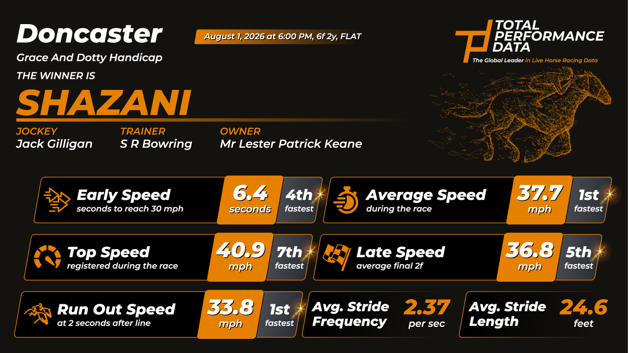
Our best bet on the card comes in the apprentice handicap at the end of the card. SHAZANI has won his last 2 starts and has form figures on Town Moor that include 2 wins and 3 places from 9 starts. Both recent victories have come when he has been able to make all of the running and having recorded the quickest time for the opening furlong in each of his 3 starts at the track this year, he seems highly likely to lead once again from stall 5.
The handicapper has given him a 5 lb rise but with Joe Bradnam claiming 7 lbs off his back he is still very fairly treated on his current mark. The winning times for both successes were under the TPD expected time figures for the races at Doncaster and Beverley. Roy Bowring may not have as many runners as he used to these days, but 3 of the 6 winners that he has sent out in the last 12 months have come at Doncaster. The yard has had 10 winners and 18 placings from the 36 hat-trick seekers that they have sent out in the last 20 years and the times of Shazani’s recent successes would suggest that he may be able to add to that impressive haul in Sunday’s finale.
Back – “Shazani” (Win & Place if leaving as an outright wager) Back and hedge as appropriate, as the race progresses, if trading.
You can find sectional times, stride data, speed statistics and jumping performance metrics on the At The Races RESULTS page.
The global database of sectional times, stride data and performance metrics is available through Total Performance Data.
Saturday 12th September 2026
Tomorrow is Betfred St Leger day at Doncaster. The final Classic of the 2026 season is the feature race on Saturday’s card on Town Moor, with the St Leger due to start at 3:35pm. Our analyst Adam Mills has looked at the feature race itself, as well as highlighting an angle into the Champagne Stakes earlier in the day as part of his latest dive into our data.
1:45 – Betfred Champagne Stakes
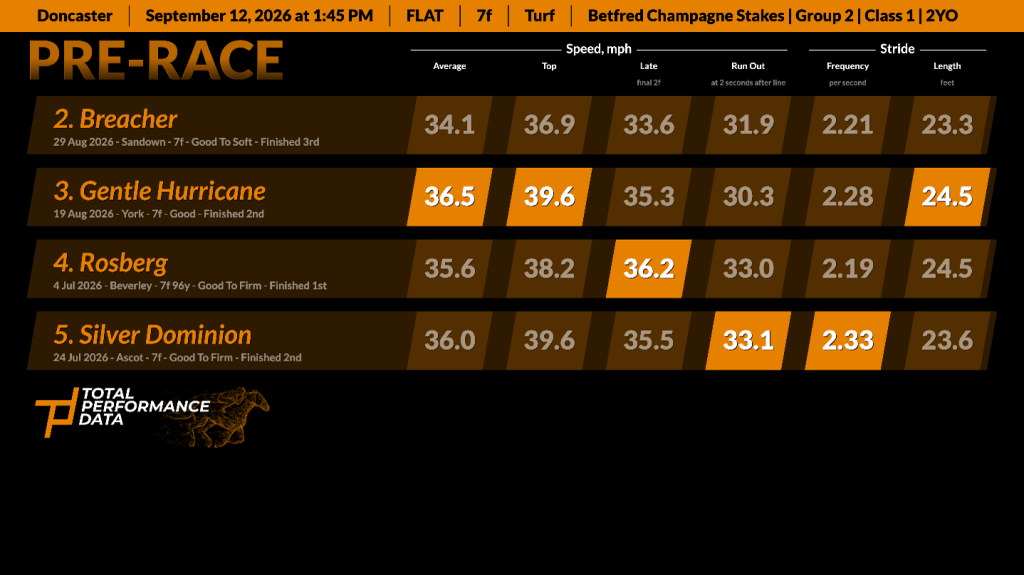
The pre-race graphic above has a clear omission. Desert Castle is a short-priced favourite for this year’s Champagne Stakes at Doncaster and that’s more than fair. Had we included him in the Graphic above, it would have shown that the in-race metrics that he recorded when winning at Newmarket in August were faster than any of his rivals have so far achieved. After just 1 run in a confined maiden, he does need to go and prove that he can build on that impressive debut, but his data does look to set him apart.
However, the more interesting angle comes when we look at the horse who is most likely to chase him home if he does prove to be too good. GENTLE HURRICANE was the horse who stood out. At an average of 24.5 ft, his stride length (recorded when he was 2nd in the Acomb at York) is the longest of those with form in the UK and was above the expected average for a winner over the course and distance last time. He found Haffner too strong, but he recorded a faster top speed figure than the winner and his time for the final quarter of a mile was just 0.09s slower than Aidan O’Brien’s winner.
The key for Gentle Hurricane is the pace. With the longest expected stride length in the field, a tactical race with a sprint finish is less likely to suit and his peak average stride frequency at York (2.34 strides per second) would agree with that opinion. It’s definitely not a coincidence that the winning time in the Acomb of 1:25.96, with a finishing speed of 97% from the winner meant that Gentle Hurricane was able to use his long stride to chase the winner home, although having been alongside the winner at the furlong pole, it may have been seen as a slight disappointment when he was left 2 lengths behind at the line.
The key is that stride frequency figure and so this approach needs to be with the view that Gentle Hurricane is backed in running, with the caveat that the pace needs to be an honest one. On “Good to Soft” ground, our expected time figure for this race is 1:26.53, which means we would be looking for the early leaders to cover the opening quarter of a mile in no more than 27.5s. If that happens, the pace ought to be fast enough to allow Gentle Hurricane to use his stride to best effect.
In-Running Angle – Back Gentle Hurricane (A Place bet if not hedging) if the leader covers the opening quarter of a mile in under 27.5s. Hedge appropriately as the race progresses.
3:35 – Betfred St Leger Stakes
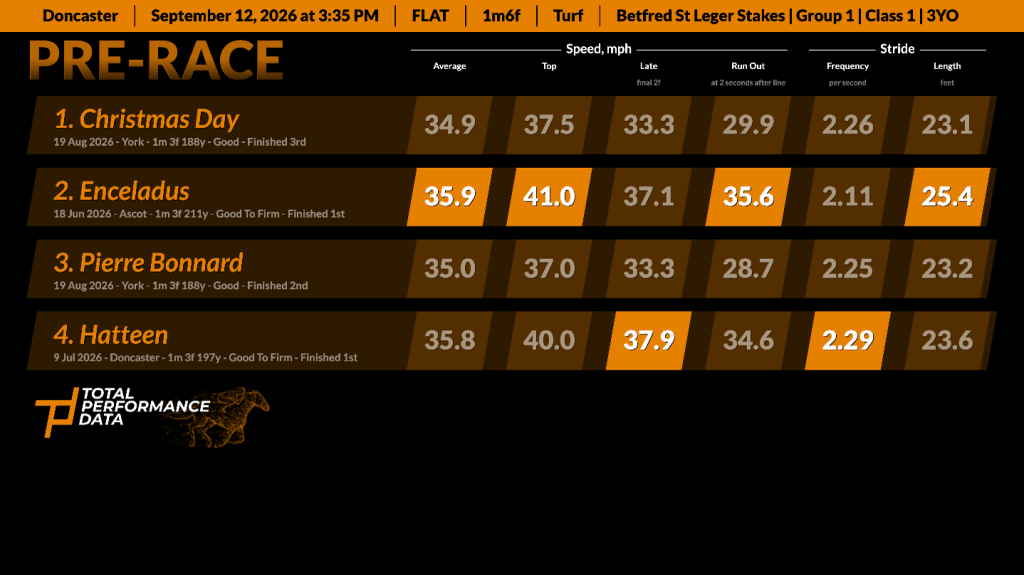
I have allowed myself a little bit of creative licence with the graphic above by excluding the form from Goodwood. My reasoning is sound because the downhill nature of the home straight at Goodwood can create a false impression with some of the late speed data when it is transferred elsewhere. So for the purposes of the graphic above I have used Enceladus’ run at Royal Ascot and Hatteen’s run at Doncaster in July for comparison purposes. I would draw particular attention to the stride length column on the right-hand side.
As you can see, Enceladus recorded a much longer average stride length figure than any of his main market rivals. That could prove to be key in a race where the last 2 winners have recorded average stride length figures of 24.7 ft. In fact every horse in last year’s race, won by Scandinavia, recorded an average stride length figure above 24 ft. Continuous (2023) showed that this race can be won with a shorter stride length (23.10 ft average), but the long straight at Doncaster which comes at the end of this extreme trip does appear to favour those with a longer reach. A field of 11 going to post would offer the distinct possibility that this race will have some early pace to ensure that it is truly run and given the considerable amount of improvement that Joseph O’Brien’s charge has found this year, he rates as the most likely winner of the final classic of 2026.
Back – Enceladus and hedge appropriately as the race progresses.
You can find sectional times, stride data, speed statistics and jumping performance metrics on the At The Races RESULTS page.
The global database of sectional times, stride data and performance metrics is available through Total Performance Data.
Friday 11th September 2026
We head back to Doncaster on Friday afternoon for the second day of the Betfred St Leger Festival. Our analyst has once again taken a look through the 8 race card and highlighted a couple of key angles from our pre-race data to note ahead of Friday’s action.
1:15 Doncaster – Betfred Flying Scotsman Stakes
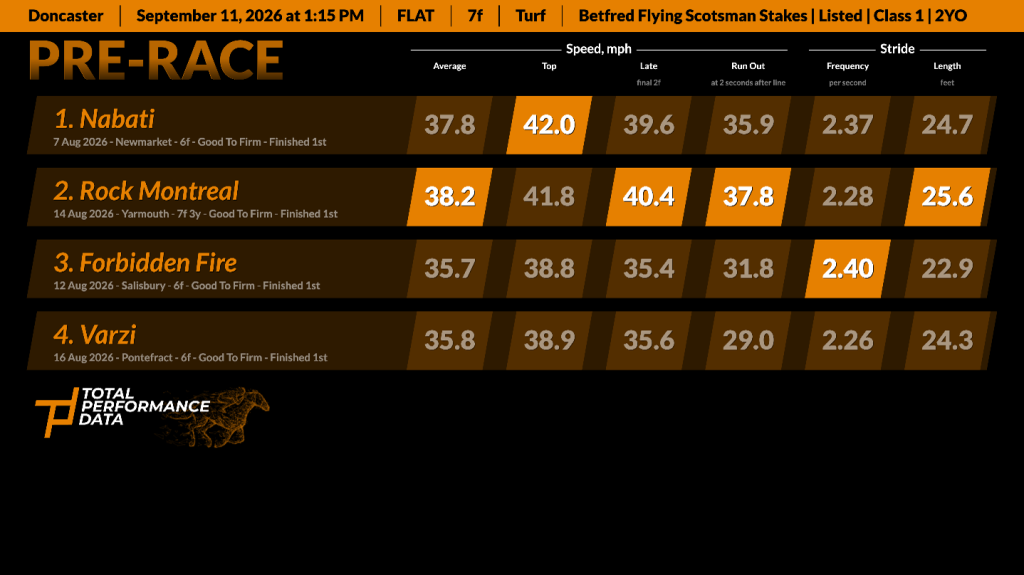
A race that would appear to revolve around the pair of Godolphin runners. At the time of writing, the early markets have Nabati as the short-priced favourite and after winning twice and chasing home the Gimcrack winner Arapaho Gold in between those 2 victories, he does set the standard. However, as our pre-race summary above shows, ROCK MONTREAL produced a set of in-race metrics at Yarmouth that would suggest he may be more than capable of giving Nabati something to think about. His winning time of 1:22.71, more than 2s faster than the TPD expected time figure, gave Rock Montreal an average speed figure of 38.2 mph, faster than any of his main market rivals were able to achieve in their latest starts over a furlong shorter.
At an average of 25.6 ft, Rock Montreal has an enormous stride which was 1.8 ft longer than the expected average for a winner over the 7 furlong trip at Yarmouth and it would suggest that Rock Montreal is capable of developing into a stakes class performer. For a such a long striding horse to record consecutive sub-11s furlongs on his debut was certainly eye-catching and both his late speed (40.4 mph) and run-out speed (37.8 mph) figures were the fastest recorded by any horse running over the 7 furlong trip at Yarmouth so far this year. Rock Montreal ticks a lot of boxes from a data perspective and the presence of another runner in his owner’s famous colours means that he is perhaps being slightly overlooked at present.
Back – Rock Montreal (if more than 1pt bigger than Nabati). Hedge as appropriate depending upon how the race pans out.
3:00 Doncaster – Betfred Howard Wright Doncaster Cup Stakes (G2)
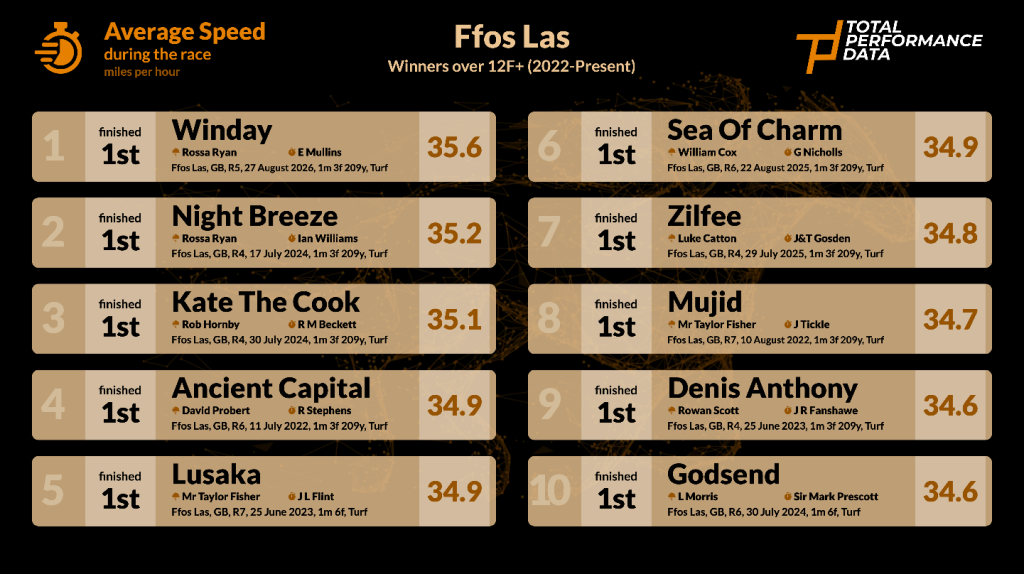
If we were to take the handicapper’s opinion as gospel, then this race would look to revolve around Caballo de Mar. He comes into this race with an official rating of 115 and Group 1 success already on his CV.
At the weights, there should be nothing between Caballo de Mar and Queenstown, although the latter’s win in the Irish St Leger trial was his only success in 9 attempts in pattern company. Both have their merits, especially at this level, but there is an angle to be made from our data with one of the least exposed runners in the field, WINDAY. Officially he has a lot to find, but some of the data from his recent victory at Ffos Las would offer some hope that this is a lot more than just a fanciful entry from his connections. A winning time of 2:31.08 was over 5s faster than the TPD Expected time for his victory at Ffos Las and that time gave him the fastest average speed figure of any horse to run over 1 mile and 3 furlongs or further at the Welsh course in the last 5 years.
Whilst we do need to acknowledge that Ffos Las is not a Grade 1 track, that time figure was still exceptional and it would suggest that Winday is at least worth a try at this level. Queenstown would appear to be the most obvious pace angle in this year’s race, but there were limited options when we tried to assess which of the 8 runners were most likely to force the early pace. As a result, this seems likely to develop into a tactical contest. Winday recorded a top speed of 39.6 mph when winning at Ffos Las, far above our expected figure of 38.4 mph for a winner of this race at Doncaster.
There is a chance that Winday may find this stiff rise in class to be too much and this selection also comes coupled with the chance that Ryan Moore will dictate the fractions to suit Queenstown in front. For that reason, this would be advised as a win and place bet in running if Winday is in the right position. But if he is within 3 or 4 lengths of the leader (or less than 0.5s) at the 4 furlong pole, Emmet Mullins charge could prove to be capable of upsetting the more established horse, with a significant weight-for-age allowance in his favour.
“In-Running Advice” – Back – Winday (Win & Place) if within 4 lengths of the leader at the 4f pole.
You can find sectional times, stride data, speed statistics and jumping performance metrics on the At The Races RESULTS page.
The global database of sectional times, stride data and performance metrics is available through Total Performance Data.
Thursday 10th September 2026
We head to Doncaster on Thursday afternoon for the first day of the Betfred St Leger Festival. Our analyst has taken a look through the eight races on the card and highlighted a couple of key angles from our pre-race data.
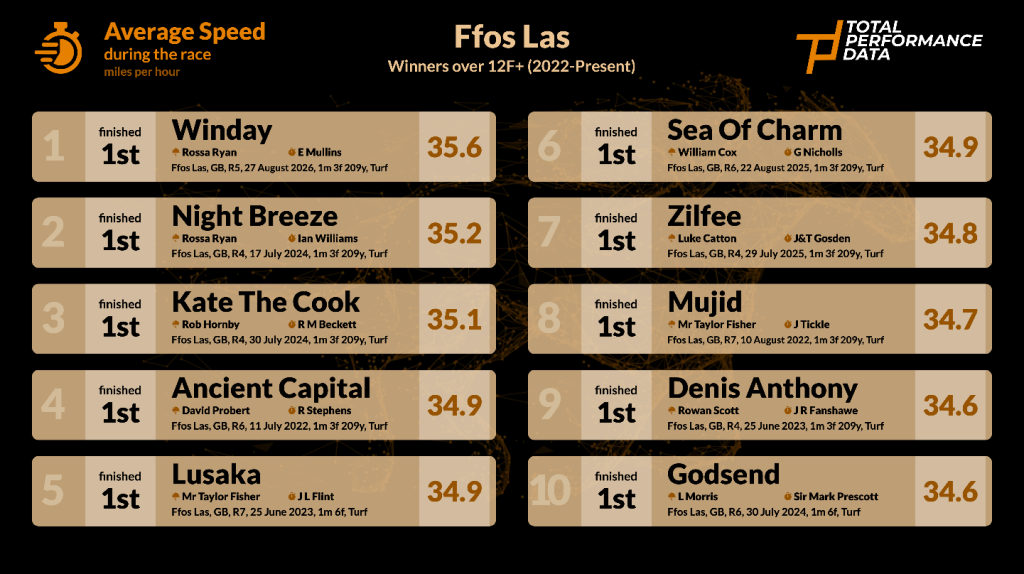
If we were to take the handicapper’s opinion as gospel, then this race would look to revolve around Caballo de Mar. He comes into this race with an official rating of 115 and Group 1 success already on his CV.
At the weights, there should be nothing between Caballo de Mar and Queenstown, although the latter’s win in the Irish St Leger trial was his only success in 9 attempts in pattern company. Both have their merits, especially at this level, but there is an angle to be made from our data with one of the least exposed runners in the field, WINDAY. Officially he has a lot to find, but some of the data from his recent victory at Ffos Las would offer some hope that this is a lot more than just a fanciful entry from his connections. A winning time of 2:31.08 was over 5s faster than the TPD Expected time for his victory at Ffos Las and that time gave him the fastest average speed figure of any horse to run over 1 mile and 3 furlongs or further at the Welsh course in the last 5 years.
Whilst we do need to acknowledge that Ffos Las is not a Grade 1 track, that time figure was still exceptional and it would suggest that Winday is at least worth a try at this level. Queenstown would appear to be the most obvious pace angle in this year’s race, but there were limited options when we tried to assess which of the 8 runners were most likely to force the early pace. As a result, this seems likely to develop into a tactical contest. Winday recorded a top speed of 39.6 mph when winning at Ffos Las, far above our expected figure of 38.4 mph for a winner of this race at Doncaster.
There is a chance that Winday may find this stiff rise in class to be too much and this selection also comes coupled with the chance that Ryan Moore will dictate the fractions to suit Queenstown in front. For that reason, this would be advised as a win and place bet in running if Winday is in the right position. But if he is within 3 or 4 lengths of the leader (or less than 0.5s) at the 4 furlong pole, Emmet Mullins charge could prove to be capable of upsetting the more established horse, with a significant weight-for-age allowance in his favour.
In-Running Angle – Back – Winday if within 4 lengths of the leader at the 4f pole. (Win & Place if leaving as a straight back bet). If hedging, do so at an appropriate juncture depending how the race pans out.
You can find sectional times, stride data, speed statistics and jumping performance metrics on the At The Races RESULTS page.
The global database of sectional times, stride data and performance metrics is available through Total Performance Data.
3:00 Betfred Park Hill Fillies’ Stakes (Group 2)
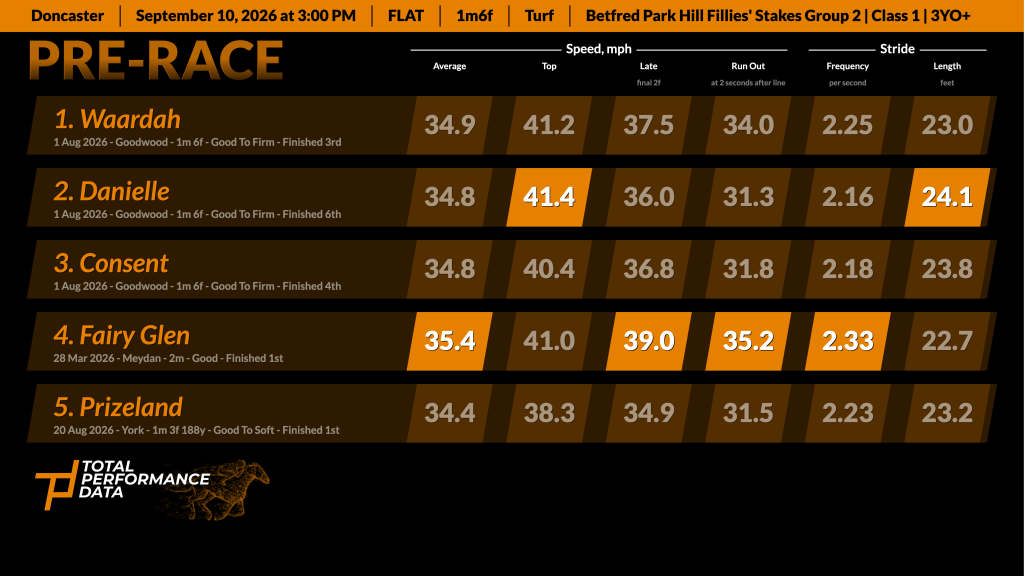
We have only seen FAIRY GLEN once since her heroics in Dubai earlier in the year, but there is a definite case to be made for this race setting up perfectly for the Crisford’s mare. As you can see from our pre-race summary, her late speed figures in the Dubai Gold Cup are some of the fastest figures on offer in this 9 runner field. That is perhaps not surprising given that she won over 9 furlongs at Meydan in February, but her above average stride frequency figure is the key. She has won 3 races over trips of 12 furlongs or more and in each of them she has recorded a finishing speed of 108% or more.
Consent seems to be the most likely pace angle in this race but there isn’t an out and out front runner in the field and so it seems probable to say that this race is likely to be run to suit. If we assume that the Good to Soft going description remains accurate on Thursday afternoon, then the expected time figure for this race from the TPD database would be 3:08.12. When looking back at the results over the 1m 6 furlong trip or further in the last 5 years, there have been 23 races when the going description has ranged between Good through to Soft. The average speed recorded by the winners has ranged between 35.5 mph (Jan Brueghel) to 30.5 mph (Carzola) with a median average of 34 mph.
On that basis, the key statistic is to look at the time it takes for the leader to cover the opening mile. If the time taken is above 1:57:00, then it would suggest that the pace has yet to develop and as a result, Fairy Glen and her sprint finish may well come into play. Her fitness does need to be taken on trust and the Crisford’s current form would raise a few question marks, but if she is ready to run her race, there is an obvious case to be made that she will have too much speed for her rivals if the early pace is sedate.
In-Running Angle; Back Fairy Glen if the opening mile takes 1:57.00 or more and hedge the position, as appropriate, later in the race.
4:10 Meadowhall X Flannels Beauty Bar Nursery
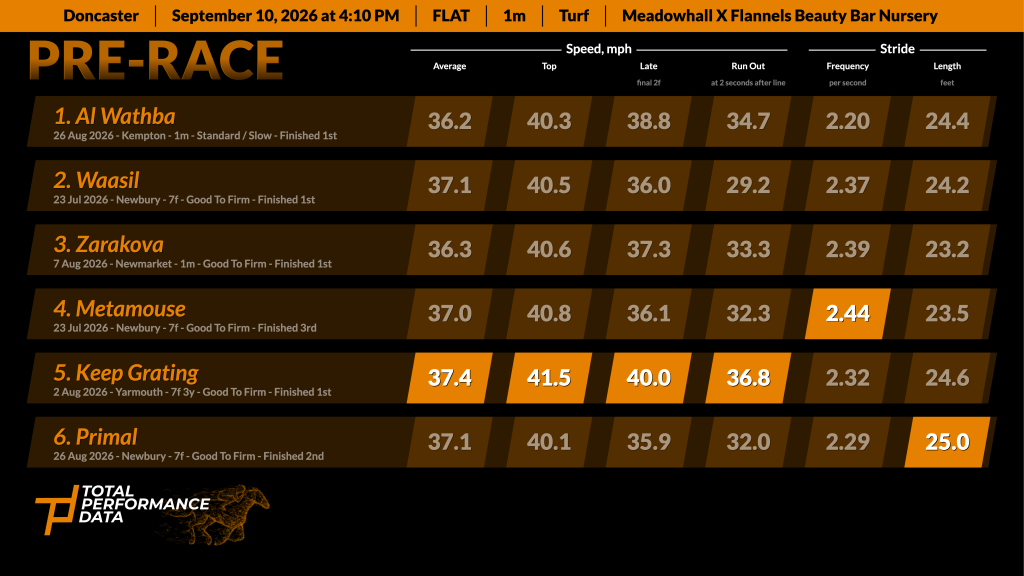
There is a race to be won with Primal, who is the only maiden in this field. The step up to the mile trip should really suit Andrew Balding’s charge, who recorded the longest average stride length in the field on his latest start at Newbury (24.98 ft). He was ideally placed on that occasion by Oisin Murphy, but simply couldn’t move his big frame quickly enough in the closing stages and his average stride frequency figure of 2.07 per second in the final furlong ranked 13th of 14.
He still clocked a final furlong split of 12.80s (3rd) which was just 0.22s slower than the winner. He will win races and is probably next year’s horse, but this should suit.
However, as our pre-race graphic shows, Primal may struggle to match Richard Hannon’s KEEP GRATING. His winning time of 1:24.44 was under the TPD expected time figure at Yarmouth and having chased the long time leader (Telegraphic) for the best part of 2 furlongs, Keep Grating eventually got on top and he was certainly doing his best work at the finish as he clocked the fastest final furlong time and run-out speed in the field. Both his average stride frequency and stride length figures were at Yarmouth were above the expected average figures for a winner over this course and distance at Doncaster. Now that he has managed to get his head in front, an opening mark of 77 could be very generous based on our stride data.
In Running Angle; Back Keep Grating and hedge the position, as appropriate, later in the race.
You can find sectional times, stride data, speed statistics and jumping performance metrics on the At The Races RESULTS page.
The global database of sectional times, stride data and performance metrics is available through Total Performance Data.