
The 250 Challenge
The Betfred St Leger Festival is one of the highlights of the flat racing season. The festival culminates with the Group 1 Betfred St Leger Stakes, the world’s oldest Classic horse race, with the 2026 event celebrating the 250th anniversary running of the historic contest.
The St Leger Festival takes place from Thursday 10th to Sunday 13th September inclusive and TPD will be running a special event.
You are invited to send us details of your best trade / back or lay bet of the day, on each of the four days of the Doncaster St Leger festival.
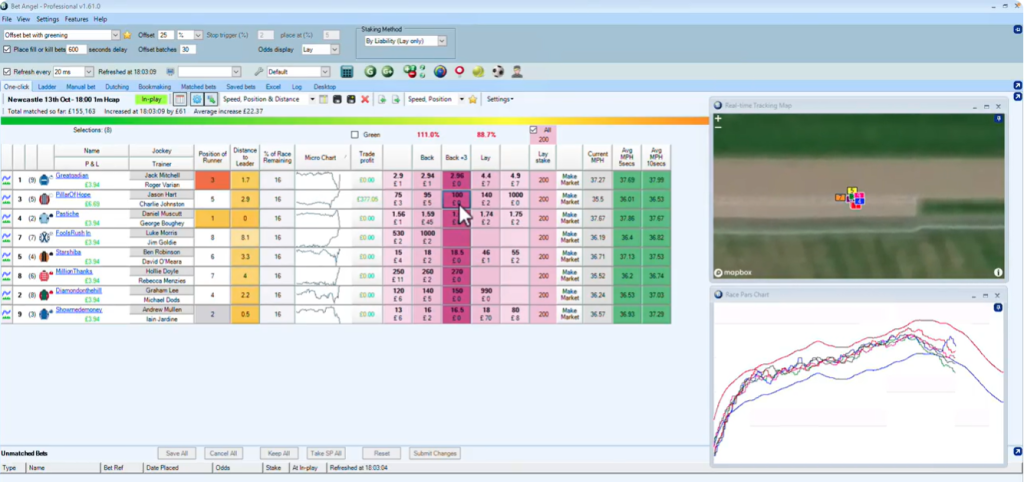
“Best trade / wager of the day” will be defined as the most effective use of the GPS data rather than the biggest ROI on the stake used. By way of example this could be identifying a favourite who is not running very efficiently, (using the efficiency metrics), Identifying, pre-race, front runners who are likely to fade if the race is run at a very fast pace etc.
Simply email support@tpd.zone with a short description of your bet / trade (what you did, the rationale of why you did it etc.) and your entry will be considered. You do not need to give away the detail of any specific strategy, just a general description. And any screen shots of innovative configurations of the Bet Angel One-Click screen and such like will be looked upon very favourably. We will publish details of the best ones whilst observing any requests for anonymity.
The Prize
On each day of the four day festival the winner will be given three months FREE access to the TPD Zone Everyday subscription plan – worth £360.
And as a Thank You for taking part, everyone who submits an entry to the Challenge will have 250 races added to their next subscription renewal.
Racing Efficiency and The TPD Metrics
The skilful interpretation of racing efficiency is in our view, one of the best routes to success with the GPS data. And to quote an industry expert;
“The key thing to bear in mind is that one of the best ways to use the data is to quantify racing efficiency in real time, to identify and lay short priced horses running with the choke out and back horses running efficiently, all at good prices.”
To see more detail of how to interpret racing efficiency CLICK HERE
Some Interesting Pointers
The following snippets may prove useful.
Group 1 races are often won by the horse who races most efficiently. At a min. average Stride Frequency of 2.06 strides per second.
Horses typically win by using their energy most efficiently or smoothly. By ranking each horse’s split time per furlong you can see who is running evenly. A potential strategy is to lay horses that are running the fastest splits very early in the race or running fast then slow then fast. Winning horses tend to save their faster splits (relative to the field) for the end of the race. A horse that is drawn wide that is then ranked 1st, 1st and then 2nd for the first 3 furlongs reveals that they have used up a huge amount of energy, relative to the field, to try and find a racing position closer to the rail.
A horse recording the fastest split times, in three consecutive furlongs, in the final five furlongs of a race would have a very good chance of winning the race, or at least coming very close.
A horse recording an increasing Stride Frequency figure in the final quarter of a mile could be a strong contender.
St Leger Daily Previews
On a daily basis Performance Data’s Racing Analyst Adam Mills will provide an informative preview of the day’s key races with a number of in-running angles explored.